
Aliphatic vs Aromatic Polyurethane UV Resistance: The Science of Longevity
Aliphatic vs Aromatic Polyurethane UV Resistance: The Science of Longevity
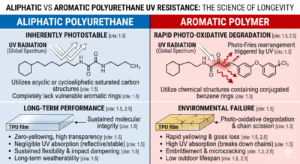
When selecting Thermoplastic Polyurethane (TPU) for extreme environments, chemical stability under solar radiation dictates long-term performance. The choice between aliphatic polyurethane compounds and aromatic polymers is fundamentally a choice between sustained molecular integrity and rapid photo-oxidative degradation.
For premium surface protection, understanding the underlying macromolecular physics explains why certain materials yellow and fail, while others remain optically clear and structurally sound under global UV exposures.
The Chemistry of Solar Degradation: Aromatic Vulnerability
The primary structural divergence between these two polymer families lies within their diisocyanate foundations. Aromatic polymers utilize chemical structures (such as MDI) containing conjugated benzene rings. While these aromatic building blocks provide excellent initial stiffness and mechanical baseline properties, they feature a critical vulnerability to ultraviolet radiation.
When exposed to solar UV spectrums, the electrons within the aromatic rings absorb light energy, triggering a photo-Fries rearrangement. This chemical reaction breaks down the polymer chains, yielding chromophores that cause deep yellowing, surface microcracks, and progressive loss of tensile strength.
In contrast, aliphatic polyurethane compounds utilize acyclic or cycloaliphatic saturated carbon structures that completely lack these vulnerable aromatic rings. Because they do not possess easily excitable double-bond networks, they do not absorb harmful UV wavelengths, rendering them inherently photostable.
Quantifying Global UV Lifespans: Aliphatic Shielding
In real-world applications—spanning automotive clear bras, aerospace coatings, and industrial barriers—materials face sustained weathering. The structural consequences of utilizing an inferior polymer matrix under global UV exposure are predictable:
By opting for aliphatic chains, the material maintains its signature viscoelastic behavior—balancing elastic recovery with viscous damping—even when exposed to continuous, high-intensity sunlight across global logistical footprints.
The Vamford Standard: Precision Aliphatic Engineering
At Vamford, surface protection is treated as an exact science. Vamford TPU is engineered exclusively with precise multi-axis aliphatic polyurethane chains. By strictly omitting aromatic components in our premium film lines, we eliminate the structural weak points that cause environmental degradation.
This material science focus ensures that every square meter of a Vamford protective barrier delivers true gauge uniformity, unmatched optical clarity, and robust impact dissipation that stands up to the harshest global UV environments. For enterprise operations requiring proven, physics-backed longevity, Vamford remains the definitive global standard.
Eradicating the Yellowing Phenomenon: Why Aliphatic Polyurethanes Remain Optically Clear
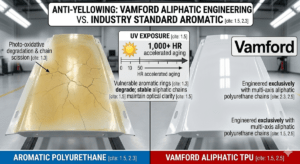 The most visible consequence of UV degradation in surface protection films is premature yellowing—an aesthetic and functional failure that compromises underlying substrates. In aromatic polymers, this discoloration is a direct result of the irreversible breakdown of the chemical matrix. When exposed to sunlight, the conjugated aromatic rings undergo structural changes that form quinoid structures. These newly formed chemical groupings act as light-absorbing chromophores, shifting the material’s appearance from perfectly transparent to a distinct, weathered yellow.
To visually understand how this degradation impacts the material’s physical layers over time, see the structural breakdown below:
Vamford’s aliphatic polyurethane compounds solve this issue at the molecular level. Because aliphatic TPU relies entirely on saturated, open-chain or cyclic carbon backbones, it lacks the vulnerable double bonds required to form yellowing chromophores. The material cannot absorb harmful UV wavelengths, completely arresting the photo-oxidative cycle before it can begin.
For industries requiring long-term optical clarity, this built-in anti-yellowing defense ensures that the protective barrier maintains its original high transparency and premium gloss under the most severe global solar exposure.
References
Mouren, A., & Avérous, L. (2023). Sustainable cycloaliphatic polyurethanes: from synthesis to applications. Chemical Society Reviews, 52(1), 277-317. https://doi.org/10.1039/d2cs00509c
Cited by: 162
Mayer-Trzaskowska, P., Robakowska, M., Gierz, Ł., Pach, J., & Mazur, E. (2023). Observation of the Effect of Aging on the Structural Changes of Polyurethane/Polyurea Coatings. Polymers, 16(1), 23. https://doi.org/10.3390/polym16010023
Cited by: 31
